Class 3 - Shapes, patterns
[last edited: 7/14/07]
In this class we will deal with shapes and patterns.. The ideas presented here can be adapted
to create a wide variety of objects, for purposes of modeling, set decoration (ornamentation), effects, etc.
Hexagonal grid
Here is a
program to create a hexagonal grid.
Usage: genHexGrid <chainLen> <nCols> <gridRad> <hexRad>
Eg: genHexGrid 8 8 1 1
Useful functions:
- curve
- polyCreateFacet
- sin
- cos
- eval
- evalEcho
Symmograph
This
program reads points from a text file and generates lines between them, Symmograph-style. Each input line should consist of 11 'tokens' [see below]. Each line begins with an 'L', followed by three points (x,y,z for each). The last entry is the number of line subdivisions. If the points P1, P2 and P3, the generated lines appear to create an arc between P1 and P3. The input file can have several such trio of points, to create multiple bundles of lines.
This is the file format:
# arbitrary comments..
L <x1 y1 z1> <x2 y2 z2> <x3 y3 z3> <n>
...
# sample file, with just one trio of points [this is a comment line]
L 1 0 0 0 0 0 0 1 0 20
Usage: curveFromLinePairs <inputFilename>
Eg: curvesFromLinePairs "C:/temp/funData.dat";
Useful functions:
- fopen
- fgetline
- fclose
- tokenize
- sqrt
- curve
- eval
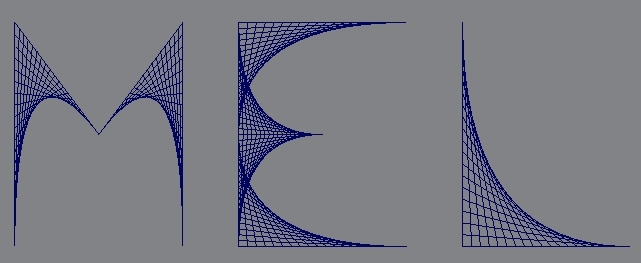
The following data produces the lines shown underneath.
The foll. spell out MEL :) (plot the pts on a grid and see for yourself).
Place the following 7 lines in a text file called MEL.dat (for example),
then do something like:
curvesFromLinePairs "C:/temp/MEL.dat";

L 3 4 0 0 8 0 0 0 0 20
L 3 4 0 6 8 0 6 0 0 20
L 14 0 0 8 0 0 8 4 0 20
L 8 0 0 8 4 0 11 4 0 20
L 11 4 0 8 4 0 8 8 0 20
L 8 4 0 8 8 0 14 8 0 20
L 16 8 0 16 0 0 22 0 0 20
Double conical pendulum
This
program plots 'double conical pendulum' (
Pendulum
Harmonograph) curves!
Usage: dcp (float $a1,float $a2, float $b1,float $b2, float $c1,float
$c2, float $d1,float $d2, float $e1,float $e2, float $f1,float $f2, float
$incrT, float $endT);
$a1, $a2...$f1,$f2 are 12 values that determine the curve shape. $incrT is an
angle increment, $endT is the end angle (start angle is always 0).
// Example:
dcp 1 3 2 -1 2 1 2 -1 -2 -1 .5 5 .05 200; // 'spider web' pattern
// see the dcp.mel source for many more interesting examples..
Useful functions:
- sin
- cos
- curve
- evalEcho
- catch
Exercise: modify this program to work on any polymesh instead of reading points from a data file. Create symmographs between adjacent triplets of vertices of each poly in the polymesh. Eg. in a triangulated mesh, each poly is a triangle, with
three symmographs (if the triangle verts are A, B and C, the symmographs will be generated using (A,B,C), (B,C,A) and (C,A,B) as inputs.
Also, add a 'gamma' parameter to the program, to use while interpolating. In code, currently we have
$p1x = $x1 + ($x2-$x1)*($i*$delta1);
$p1y = $y1 + ($y2-$y1)*($i*$delta1);
$p1z = $z1 + ($z2-$z1)*($i*$delta1);
The idea is to use the new 'gamma' value to make the interpolation non-linear (non-uniform-spaced) by using pow(($i*delta1),$gamma) instead of ($i*$delta1).
Trefoil knot
This
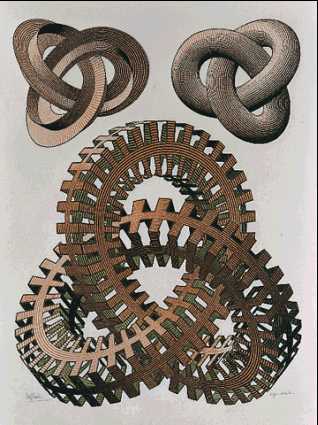
program plots a trefoil knot made
famous by Escher:
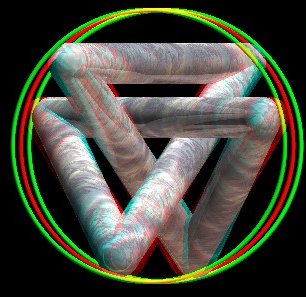
A stylized, anaglyph (red-green) 3D version by Alain Esculier:
Usage: trefoilKnot; // no inputs
Useful functions:
- sin
- cos
- curve
- evalEcho
- catch
Star-shaped polys
This
program creates (regular) star polygons.
Usage: genStars (int $n, float $angOffset, int $ax, float $len1, float $len2);
Eg: genStars 6 0 0 1 3;
Useful functions:
- sin
- cos
- curve
- polyCreateFacet
- evalEcho
Penrose tiles
Penrose tiles are 5-fold-rotationally-symmetric, aperiodic tilings (unusual!):
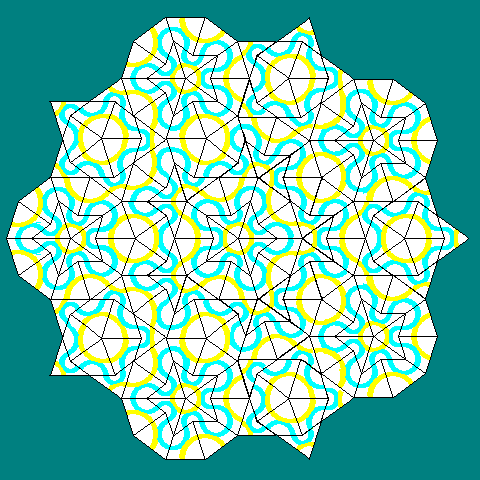
[above image is by Steven Dutch]
This program creates Penrose tiling patterns..
Usage: penroseInflate(int $recurDepth, string $datFilenm);
Eg. penroseInflate 4 "C;/tmp/tst.dat";
Add'l procs that can be invoked:
genDart();
genKite();
To see it in action, do:
rehash;
genDart(); // produces a single 'dart'
// now create 4 more darts by duplicating the above one 4 times
// and rotating them by 72, 144, -72 and -144 degrees
// select all 5 darts, then do this:
penroseInflate 4 "C:/temp/tst.dat";

// Instead of starting with a dart, you can start with a kite and duplicate
// that 4 more times
genKite;
// duplicate and rotate as above, and call penroseInflate() as in above
Useful functions:
- sin
- cos
- sqrt
- attributeExists
- polyEvaluate
- polyCreateFacet
- select
- rename
- xform
- addAttr
- setAttr
- getAttr
- fopen
- fprint
- fclose
- listRelatives
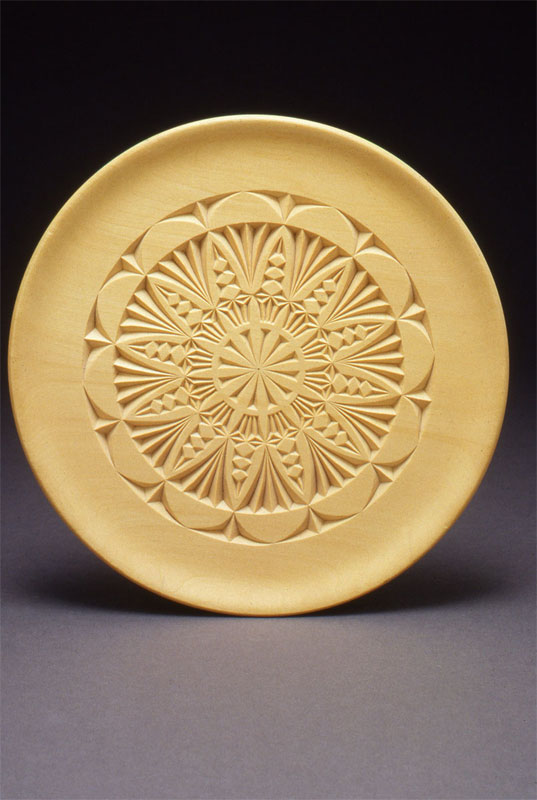
Chip carving
Chip-carving is a wood-carving technique where specialized knives are used to create ornamentation on flat wooden surfaces (boxes, plates, doors..). The idea is to create designs from tetrahedral gouges by making three precise, angled cuts.
Here is a program to create 'chip-carved' cuts over
tris in a mesh. It subdivides each triangle into three, and depresses (displaces) the midpoint along the original tri's normal, by a user-specified amount.
Usage: chipCarve(string $meshNm, float $offset);
Eg: chipCarve "octahedMesh" 0.05;
Useful functions:
- polyEvaluate
- polyInfo
- polyCreateFacet
- tokenize
- xform
- warning
Here is a photo of a real chip-carved plate:
Disco ball
This one is a
disco ball generator program.
Usage: discoBall(float $R, int $nRows, float $mirrorSize);
Eg: discoBall 3 16 0.9;
Useful functions:
- sqrt
- ls
- normalConstraint
- select
- delete
- polyCreateFacet
- polyCube
- scale
- move
Tetrahedron
Here is one way to create a poly
tetrahedron shape. The tetrahedron is one of the only five Platonic solids in 3D space (others being octahedron, cube, icosahedron and dodecahedron), where the number of faces (F), edges (E) and vertices (V) obey a simple, special relation: F+V = E+2. Maya already lets us create these, of course, but here the emphasis is on learning to do it ourselves.. Also, see
Danny Ngan's page for a program that creates all the Platonic solids (except cubes).
Usage: polyTetrahedron( float $side )
Eg: polyTetrahedron 1.0;
Useful functions:
- polyCreateFacet
- polyUnite
- select
- sqrt
Boy's surface
This
program calculates the famous 'Boy's Surface' shape
and creates a mesh to portray it.
Usage: BoysSurf(float $paramA, float $paramB, int $stepsTheta, float $stepsTau)
Eg. BoysSurf 0.5 -.05 40 40;
paramA, paramB are usually 0.6667 and 1.414 respectively. Here's how the surface is parametrized:
x = A (cos(u) cos(2v) + B sin(u) cos(v)) cos(u) / (B - sin(2u) sin(3v))
y = A (cos(u) sin(2v) - B sin(u) sin(v)) cos(u) / (B - sin(2u) sin(3v))
z = B cos(u) cos(u) / (B - sin(2u) sin(3v))
where A = 2/3 and B = sqrt(2)
and 0 <= u,v <= pi
Useful functions:
- polyCreateFacet
- polyUnite
- sin
- cos