- image raster: pixel array
A RECTANGULAR collection of picture elements. Each pixel is a 'cell', with an (i,j) index running from (0,0) to (xres-1,yres-1)
pixel array
- point operations - eg. brightness, contrast.., color->grey
Point ops involve a calculation on JUST one pixel at a time, repeated for all pixels in an img.
Brightness: color <- color*brightness_value.
brighness enhancement - linear
The brightness factor can be made non-linear first, using a bias() function:
bias(b,t) = t^(ln(b)/ln(0.5))

When brightness is non-linearly adjusted this way, it's called "gamma correction".
gamma correction
Contrast: use a s-curve, eg. a gain() function:
gain(g,t)= if (t<0.5) then bias(1-g,2*t) else 1-bias(1-g,2-2*2t)/2
contrast enhancement
Color correction - modify R,G,B values of pixels, often using a lookup table or a 'transfer curve'
Here is another point process:
solarization
Color correction demo
Likewise, converting RGB image to "black and white" (grayscale, really) is also a point operation.
RGB -> gray
Operations such as color cycling, posterization (quantization), histogram equalization, etc. are also point processes.
- area operations - 'convolution' - blurring, sharpening, edge detection
Here we compute a new value (color/grayscale) for each pixel by considering pixels in its neighborhood also, not just the pixel being processed. The rectangular grid of multiplication (scale) factors around a pixel's neighborhood (including itself) is called a 'convolution kernel' or 'mask'. You can imagine this mask being slid over every pixel to alter its value (compute a replacement).
Convolution - 1
Convolution - 2
Convolution - 3
Convolution - 4
- inverse/reverse mapping
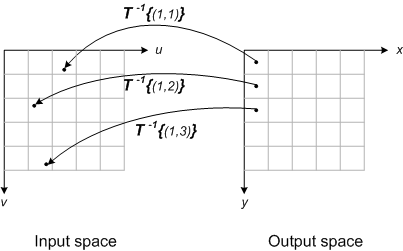
When it comes to non-point/non-kernel processes (eg. image distortion), 'forward mapping' (calculating where source pixel ends up on a target grid) can cause overlaps/holes! So what's commonly done is 'inverse mapping', where every target pixel is synthesized from source pixels.
inverse mapping
- resizing - filters
While resizing images, we use filters such as 'box', 'triangle' and 'bicubic'.
Bicubic interpolation
- image warping, use of noise, uv-based lookup
Lecture from Princeton U.
Another page on warping
One more..
- lens corrections
These are special warps meant to (de)warp imagery..
Dewarping
Warping/Dewarping
Warping/Dewarping - more
- texture, displacement,normal maps
Texture mapping - 1
Texture mapping - 2
Texture mapping - 3
Texture mapping - 4
Texture mapping - 5
Texture mapping - 6
Texture mapping - 7
Displacement mapping
In normal mapping, we use an image (normal map) to look up normals for lighting purposes.. So it is really 'texture based bump mapping"..
Normal mapping
- combining images - adding, etc.; use of alpha channel
Compositing
- image synthesis: simple patterns (ramp, checkerboard..), CA, fractals, genetic algorithms, IFS, chaos..
You can create a variety of patterns, pretty images, etc. by CALCULATING a color/grayscale value for each pixel..
Link: http://en.wikipedia.org/wiki/Mandelbrot_set